From the Archive
What a $1.50 Portrait Teaches Us About Craft, Identity, and Belonging
Sylvanus C. Foss and Mary Jane Foss, 1836
In 1836, a farmer with a paintbrush walked into a household in rural New Hampshire and made a watercolor of two siblings for a dollar fifty. The painting now resides in the American Folk Art Museum.
This is what it carries.
The Unhurried Hand
There is a man about whom almost nothing was known for over a century. Born in 1811, he started painting portraits at twenty-one, spent five short years traveling between border towns, and then stopped entirely. His name was Joseph H. Davis, though his identity was not confirmed until 1989.
He was self-taught. He was deliberate.
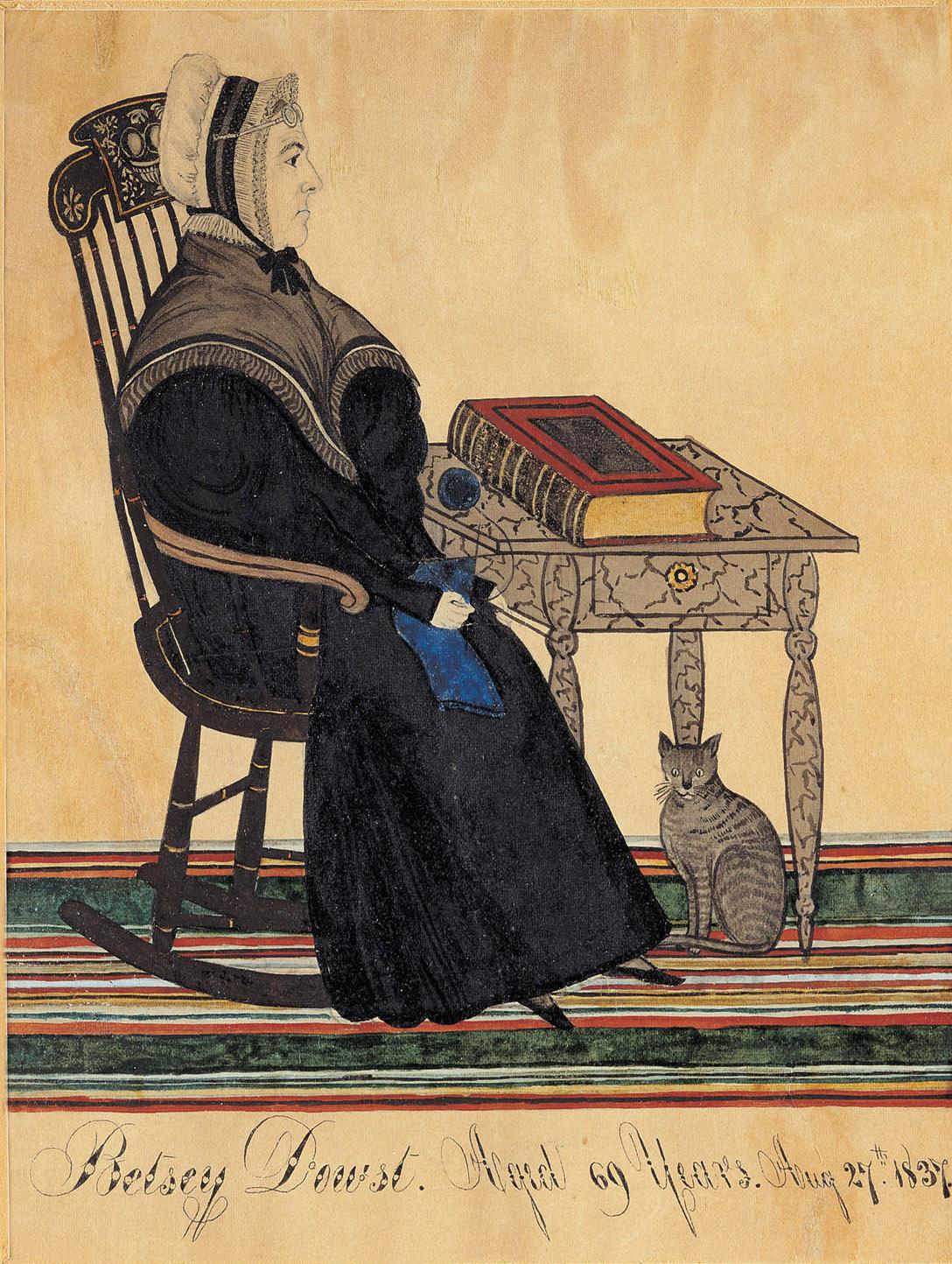
In his work, line work is calligraphic, assured, and decorative. Floors are rendered in bold geometric patterns. Furniture is documented with the exact precision of a cataloger: grain-painted tables, neoclassical klismos chairs, clocks, and floor cloths.
At the bottom of each portrait, in fine ink, Davis inscribed the name, age, date, and location. These inscriptions are quiet, permanent records of existence.
The Power of Intention
American folk portraits of this period were never candid. Every element in the frame was a deliberate choice:
- The blue klismos chairs: derived from ancient Greek forms, signaling awareness of contemporary design standards.
- The grain-painted table: a skilled, intentional surface treatment valued for its decorative craft.
- Books and instruments: precise attributes indicating literacy, discipline, and household refinement.
These objects were not chosen for display. They were chosen as evidence — proof of a household built on enduring standards and careful choices.
Community and Connection
Davis did not advertise. He moved through a tightly connected network of families linked by the Freewill Baptist Church. Word of mouth carried his practice from one home to the next.
In many portraits, Davis discreetly included the church's newspaper, the Morning Star. It was a quiet signal of affiliation — legible to those within the community, invisible to those outside it. It was a subtle form of belonging, made permanent in watercolor and paper.
The Enduring Standard
Davis's identity remained unknown for 124 years after his death, yet his work found its way into major national collections on its own merit. The quality of observation, the specificity of detail, and the confidence of composition carried the work across generations.
When a piece is made with singular care, its value does not fade with time.
What makes an object worth keeping is never its transaction price — it is what it was made to carry. A grain-painted table carries the skill of the bench worker who finished it. A watercolor carries a decision about what mattered enough to preserve.
The things we choose to make carefully, and the things we choose to keep, remain the lasting record of who we are.